WAR DEPARTMENT
Bureau of Public Relations
PRESS BRANCH
December 7, 1944
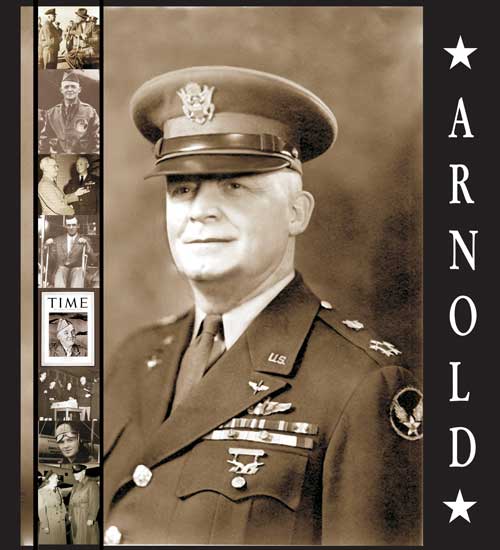
ADDRESS BY GENERAL H.H.ARNOLD, COMMANDING GENERAL, ARMY AIR FORCES,
BEFORE WASP CEREMONY, SWEETWATER, TEXAS,
THURSDAY, DECEMBER 7, 1944
I am glad to be here today and talk with you young women who have been making aviation history. You and all WASPs have been pioneers in a new field of wartime service, and I sincerely appreciate the splendid joy you have done for the AAF.
You, and more than nine hundred of your sisters, have shown that you can fly wingtip to wingtip with your brothers. If ever there was in doubt in anyone's mind that women can become skillful pilots, the WASP have dispelled that doubt.
The possibility of using women to pilot military aircraft was first considered in the summer of 1941. We anticipated than that global war would require all our qualified men and many of our women. We did not know how many of our young men could
qualify to pilot the thousands of aircraft which American industry could produce. There was also the problem of finding sufficient highly capable young men to satisfy the demands of the Navy, the Ground Forces, the Service Forces, and the Merchant Marine. England and Russia had been forced to use women to fly trainers and combat-type aircraft. Russian women were being used in combat.
In that emergency I called in Jacqueline Cochran, who had herself flown almost everything with wings and several times had won air races from men who now are general officers of the Air Forces. I asked her to draw a plan for the training and use of American women pilots. She presented such a plan in late 1941 and it formed the basis for the Air Forces use of WASP.
Frankly, I didn't know in 1941 whether a slip of a young girl could fight the controls of a B-17 in the heavy weather the would naturally encounter in operational flying. Those of us who had been flying for twenty or thirty years knew that flying an airplane was something you do not learn overnight.
But, Miss Cochran said that carefully selected young women could be trained to fly our combat-type planes. So, it was only right that we take advantage of every skill which we, as a nation, possessed.
My objectives in forming the WASP were, as you know, three:
1. To see if women could serve as military pilots, and, if so, to form the nucleus of an organization which could be rapidly expanded.
2. To release male pilots for combat.
3. To decrease the Air Forces' total demands for the cream of the manpower pool.
Well, now in 1944, more than two years since WASP first started flying with the Air Forces, we can come to only one conclusion--the entire operation has been a success. It is on the record that women can fly as well as men. In training, in safety,
in operations, your showing is comparable to the over-all record of the AAF flying within the continental United States. That was what you were called upon to do--continental flying. If the need had developed for women to fly our aircraft overseas, I feel certain that the WASP would have performed that job equally well.
Certainly we haven’t been able to build an airplane you can’t handle. From the AT-6’s to B-29’s you have flown them around like veterans. One of the WASP has even test-flown our new jet plane.
You have worked hard at your jobs. Commendations from the generals to whose commands you have been assigned are constantly coming across my desk. These commendations record how you have buckled down to the monotonous, the routine jobs which are not much desired by our hot-shot young men headed toward combat or just back from an overseas tour. In some of your jobs I think they like you better than men.
I want to stress how valuable I believe this whole WASP program has been for the country. If another national emergency arises -- let us hope it does not, but let us this time face the possibility--if it does, we will not again look upon a women’s flying organization as experimental. We will know they can handle our fastest fighters, our heaviest bombers; we will know that they are capable of ferrying, target towing, flying training, test flying and the countless other activities which you have proved you can do.
That is valuable knowledge for the air age into which we are now entering.
But please understand that I do not look upon the WASP and the job they have done in this war as a project or an experiment. A pioneering venture, yes. Solely an experiment, no. The WASP are an accomplishment.
We are winning this war--we still have a long way to go -- but we are winning it. Every WASP who has contributed to the training and operation of the Air Forces has filled a vital and necessary place in the jigsaw pattern of victory. Some of you are discouraged sometimes, all of us are, but be assured you have filled a necessary place in the overall picture of the Air Force.
The WASP have completed their mission. Their job has been successful. But as is usual in war, the cost has been heavy. Thirty-seven* WASP have died while helping their country move toward the moment of final victory. The Air Forces will long remember their service and their final sacrifice.
So, on this last graduation day, I salute you and all WASP. We of the AAF are proud of you; we will never forget our debt to you.
General Hap Arnold